Playgramma
Financial Accounting · FISAP Financial Accounting (FI), explained by playing it
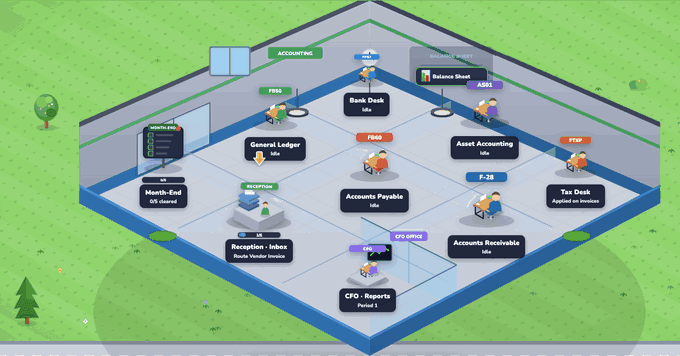
Every sale, purchase and production run eventually lands in Financial Accounting — the single source of truth for what a company owns, owes and earns. In Playgramma's FI Accounting module you run the accounting office: route documents, post journals, pay and collect, reconcile the bank and close the books.
What you'll learn
- Route documents and post journals in the ledger
- Pay vendors, collect from customers, clear open items
- Close the period and read the balance sheet & P&L
What Financial Accounting actually is
FI is the general ledger and the sub-ledgers around it. Its golden rule never changes — Debit = Credit — so every posting keeps the books balanced. The module walks the full cycle from a document arriving in your inbox to the fiscal period being locked and the statements read.
The FI cycle, step by step
These are the tasks you complete in the game, with the real SAP transaction behind each one:
- Document routed
My Inbox— financial documents flow through workflow to the responsible team. Sorting each to the right department is the first step of a clean process. - Journal Entry posted
FB50— a G/L document with a debit and an equal credit. One account goes up, another goes down, and the books stay balanced. - Supplier Invoice posted & settled
FB60 → F-53— the vendor's open item is booked with the correct input-tax code and paid through the house bank. This is Accounts Payable. - Incoming Payment cleared
F-28— the customer's payment is matched to the open invoice and the receivable is cleared. Cash in, open item gone. This is Accounts Receivable. - Bank Statement reconciled
FF67— each statement line is matched to a posted payment or receipt, so the books agree with the bank.
Assets, tax and the period close
- Asset capitalised
AS01— a big purchase is recorded as a fixed asset under its class, not expensed. DepreciationAFABwrites down its book value over its useful life. - Tax code validated
FTXP— the correct input/output tax code posts tax to the right account. A wrong code misstates the return and brings a penalty. - Period closed
OB52— with AP, AR, bank and postings cleared, the fiscal period is locked after depreciationAFABand valuationF.05. Closing the books is the heartbeat of FI. - Reports reviewed
F.01— the Balance Sheet and P&L are read to judge the company's health. This is what all the postings are for: numbers that tell the story.
The ideas to take away
- Debit = Credit, always — the balancing rule that makes double-entry accounting trustworthy.
- Open-item management — invoices sit open until matched by a payment; clearing them is how AP and AR stay clean.
- Sub-ledgers roll up to the G/L — AP, AR and assets each feed the general ledger that produces the financial statements.
Play it, don't just read it
Run the accounting office and close the books in your browser — free, no install.
Play FI Accounting →